


I suffered from IBS (Irritable Bowel Syndrome) for thirty years because I was an abusive a-hole to my gut microbiome — mostly because I didn’t know it existed. Nowadays, I treat my stomach considerably better, and it has responded the way you would expect anything to behave when you finally stop poisoning it.
Not to brag, but my morning poops are nothing short of exquisite.
THE ROUTINE
This starts immediately after capping the toothpaste.
Sunfiber Water
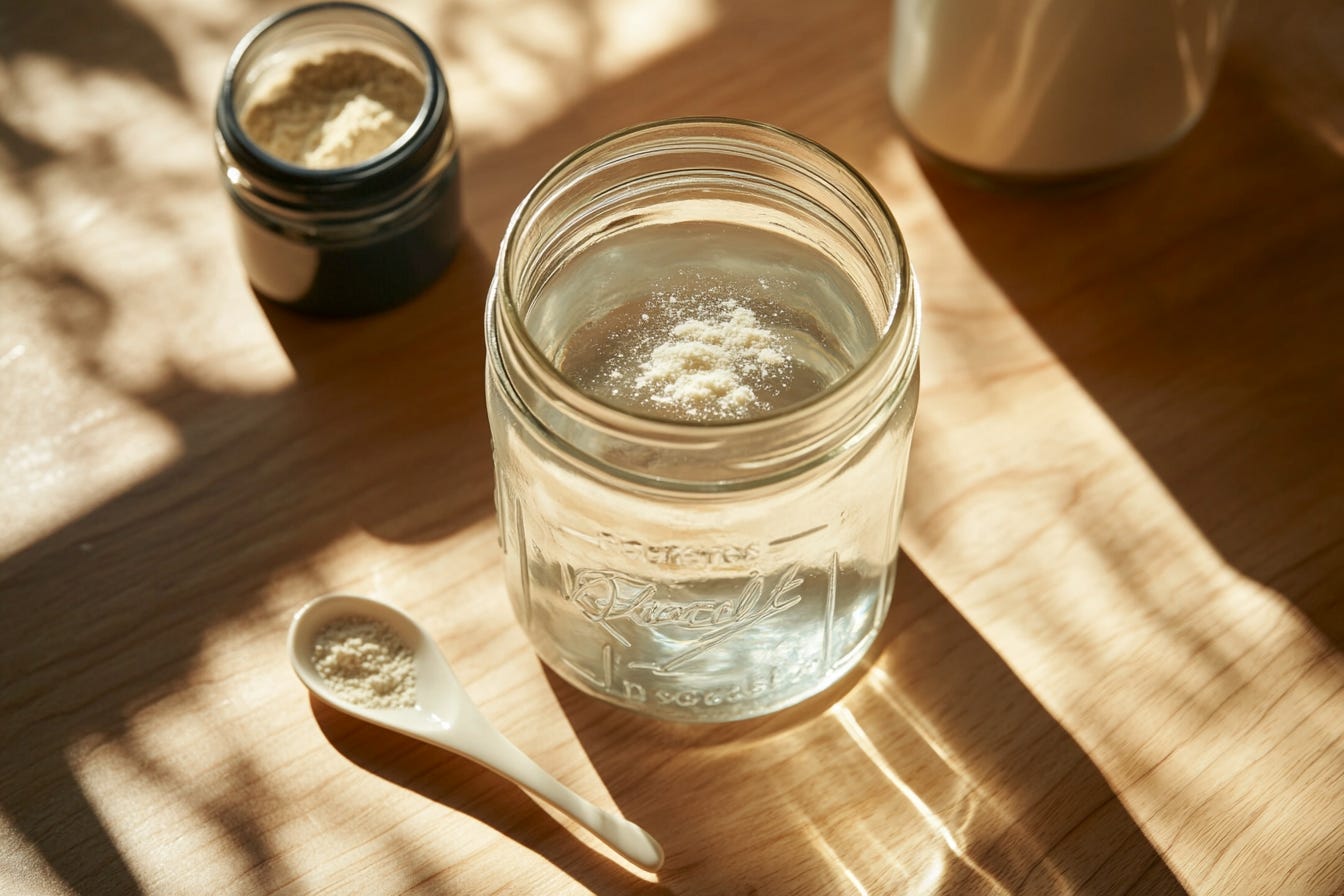
Fill a jar with 500ml water — I use a masonry jar with milliliter demarcations. Add one scoop of Sunfiber powder. Stir briskly until fully dissolved. And chug.
Start at half a teaspoon for the first week and work up slowly. The goal is a full scoop (5–6g on most labels) once your gut has adjusted. Going from zero to a full dose can lead to discomfort.
The Chia-Kefir Bowl
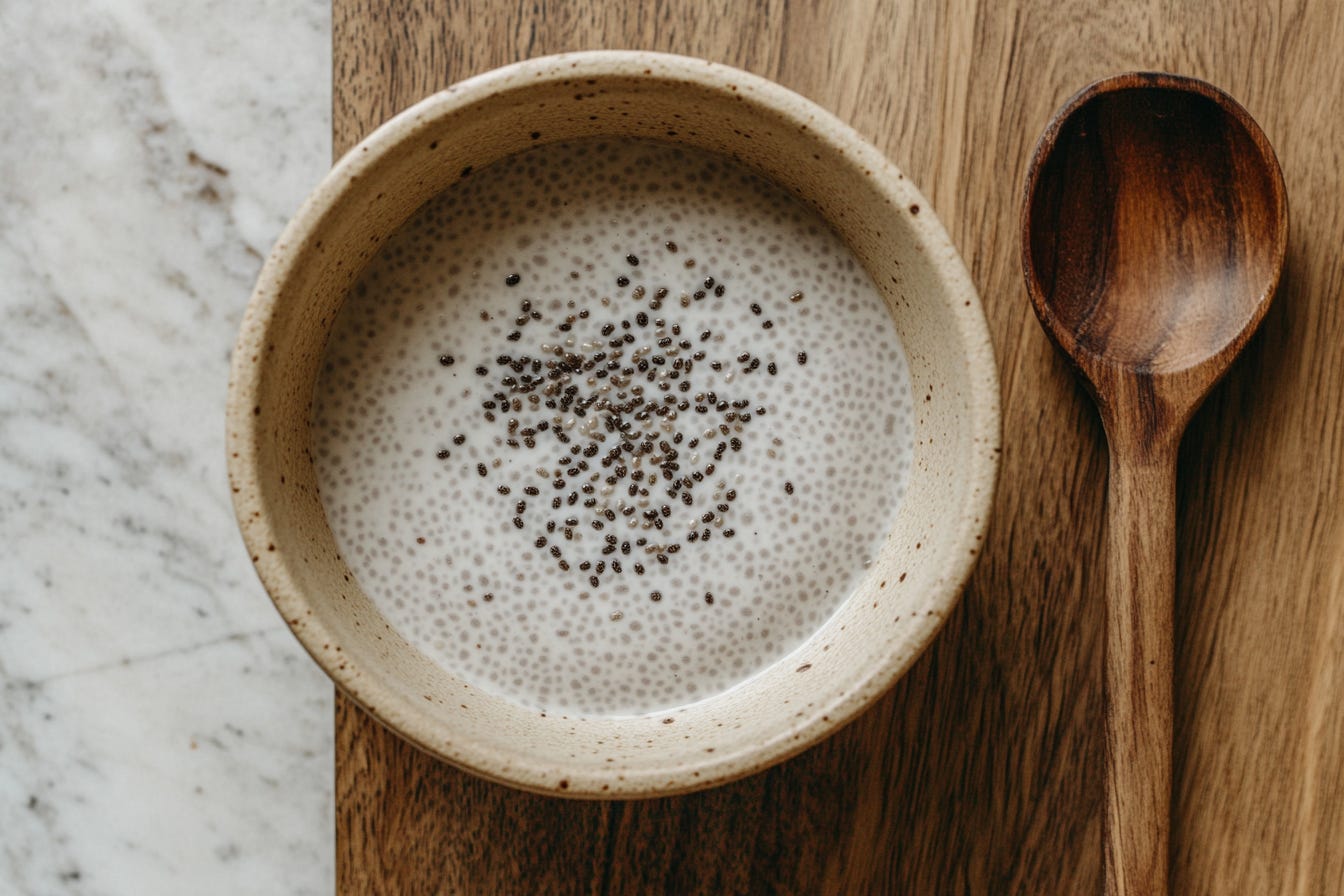
Add one tablespoon of chia seeds to a bowl. Cover with roughly half a cup of homemade kefir — 100 to 120ml. Leave it on the counter and go for a walk. By the time you’re back (thirty-plus minutes), the chia has fully hydrated and formed a soft, pudding-like base that’s absorbed the kefir completely. This becomes the foundation of breakfast. What I build on top of it is next week’s post.
Making the Kefir
This is the piece most people will skip, and also, in my experience, the most consequential one. Here is the abbreviated version:
Order live milk kefir grains online. Live, not freeze-dried — the microbial diversity in live grains is meaningfully greater. The grains themselves are actually living colonies of bacteria that resemble rice grains, hence the name. Also, there is something called water kefir for those who don’t do dairy.
Add the grains to a clean jar of fresh whole milk. I use local organic, grass-fed, pasteurized milk — never ultra-pasteurized, which alters the protein structure in ways that interfere with fermentation.
Cover with a breathable lid or cloth that allows CO2 to escape; I use a glass sourdough starter jar that works incredibly well. Leave at room temperature for 48 to 72 hours — depending on the ambient temperature and your personal taste.
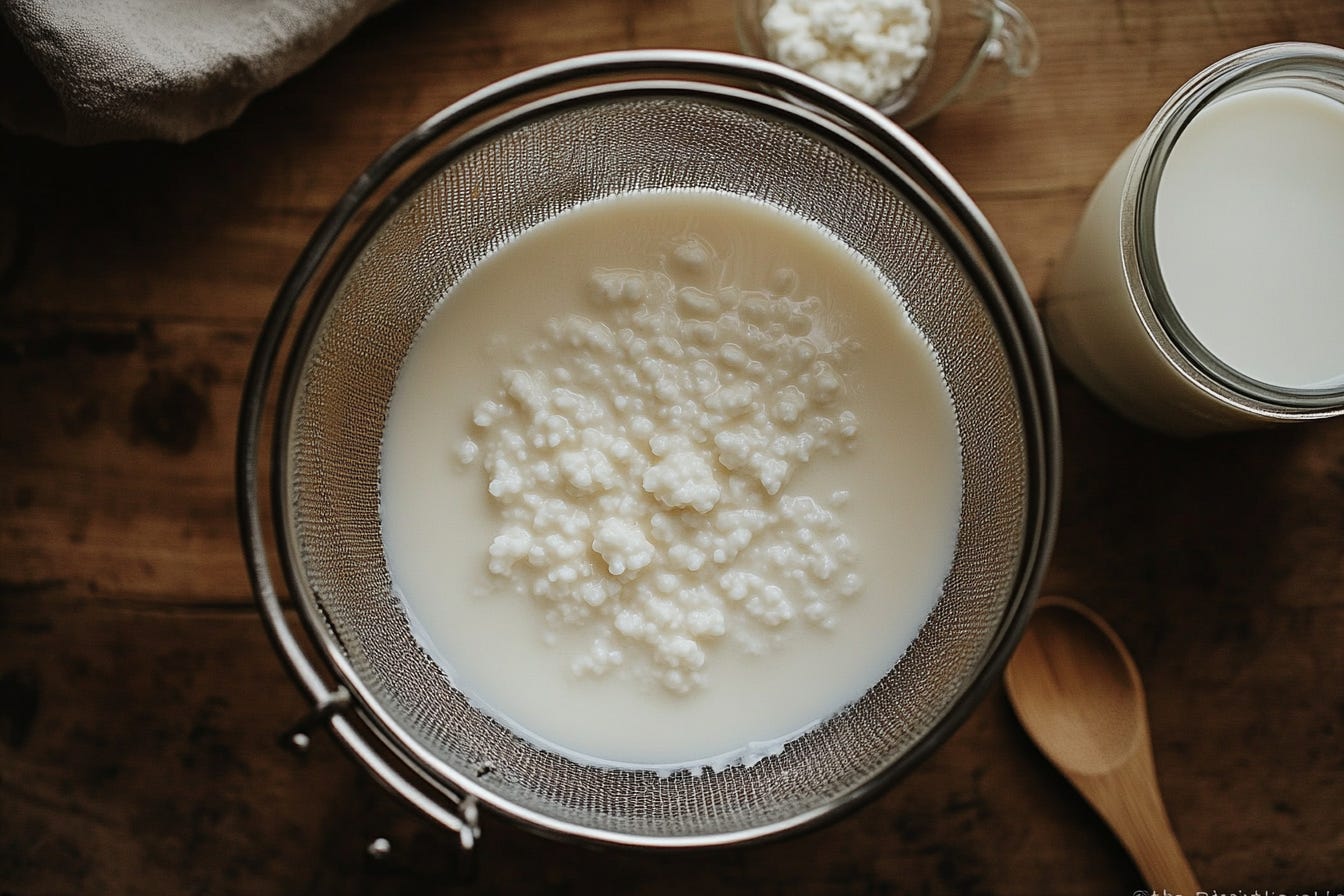
Strain through a fine mesh strainer into a funnel slotted into a glass milk jug you keep in the refrigerator. Some people rinse the grains with room-temperature water, others don’t bother.
The hardest part is clicking buy on the grains. Every subsequent batch takes just a couple of minutes. The grains reproduce and are self-sustaining indefinitely with basic care — I’ve had mine for close to a year.
THE BACKSTORY
IBS-C is the low-grade, grinding kind — featuring bloating, unpredictable (often unfortunate) timing, and extended bathroom sessions that produce frustratingly little in exchange for your gut-wrenching effort — I suddenly understand that expression!
My wife has long since abdicated any attempt at understanding why men love to luxuriate in the bathroom, though I can now report — somewhat wistfully — that the duration of my APE (Average Pooping Experience) has dropped substantially. The whole enterprise arrives every morning around coffee time with the pleasantly consistent schedule of a Swiss train.
I want to be careful not to oversell this. I have a colonoscopy scheduled for later this year, and the actual biological evidence will be revealed in the aftermath. I know you’ll be on the edge of your toilet seats for the results, which I’ll gladly share.
What changed was not a prescription or a doctor’s visit, but simply eliminating the diet I’d maintained for most of my adult life — built around the four food groups of Coke Zero; salty processed meats and cheese; white flour; and refined sugar. I replaced it with a diet that actively supports the 38 trillion or so microorganisms living in the human gut. Once I stopped treating them like squatters and more like valued tenants, everything changed.
The research increasingly connects an imbalance between good and bad bacteria to IBS symptoms, systemic inflammation, and a range of downstream effects that extend well beyond digestion.
Low fiber meant starved beneficial bacteria. The ultra-processed ingredients brought preservatives and additives broadly unfriendly to microbial diversity. The added sugar compounded the damage.
What I now do in the five minutes between brushing my teeth and putting my shoes on is the opposite. I feed the good bacteria, and then I deliver more of them into my system. That is the entire protocol.
THE SCIENCE
The framework is the synbiotic — the simultaneous delivery of a prebiotic (fuel for beneficial bacteria) and a probiotic (the bacteria themselves). If you’re trying to rehabilitate an ecosystem that’s been underfed for decades, you need both the seeds and the soil amendment.
WATER
After 7–8 hours without water, the body loses fluid through respiration and light perspiration. Multiple clinical studies have shown that many adults show markers of mild dehydration.
A randomized trial found that 500ml of water after a 12-hour overnight fast significantly improved performance on judgment and decision-making tasks. Attention and short-term memory improvements from rehydration are documented across multiple RCTs.
A 2003 study published in the Journal of Clinical Endocrinology & Metabolism found that drinking 500ml of water increased metabolic rate by 30% within 10 minutes, peaking at 30–40 minutes.
SUNFIBER
Sunfiber (the brand name for PHGG — partially hydrolyzed guar gum) is doing the heavy prebiotic lifting. It resists digestion in the small intestine and reinforces the gut barrier.
A 2016 double-blind, placebo-controlled trial by Niv et al. (Nutrition & Metabolism, 108 IBS patients, 12 weeks at 6g/day) found significant improvement in bloating scores versus placebo — bloating specifically, not overall IBS severity, which is worth being precise about. A separate 2019 randomized trial (44 participants, 5g/day, three months) showed stool-form normalization on the Bristol Stool Scale and a significant increase in Bifidobacterium. PHGG has been shown to relieve IBS symptoms across studies at doses of 5–11g/day.
CHIA SEEDS
The chia is doing entirely different work — the gel it produces when hydrated slows the rate at which food passes through the digestive tract, triggering the stretch receptors that signal fullness. It also improves stool frequency and consistency, flattens glucose spikes after meals, delivers minerals like magnesium and calcium, and helps decrease triglyceride levels.
FERMENTED FOODS
A 2025 meta-analysis published in Frontiers in Nutrition (Mukherjee et al.) pooled 19 randomized controlled trials and 4,328 participants and found statistically significant improvements in bowel movement frequency, stool consistency, and overall gastrointestinal symptom scores in healthy adults consuming fermented foods.
The landmark reference is Wastyk et al. (2021), published in Cell: a randomized trial in which 36 healthy adults were assigned to either a high-fermented-food diet or a high-fiber diet for ten weeks.
The high-fiber group’s microbiome diversity remained stable on average while—
—the fermented-food group showed consistent increases in gut microbiome diversity and significantly decreased levels of 19 inflammatory proteins in blood serum.
KEFIR
Homemade, grain-based kefir is one of the very few common fermented foods that delivers both bacteria and yeasts. (Kombucha, which I loathe, is another, but a 2024 study found that it added nothing to gut microbiome diversity).
In some analyses, kefir has been found to deliver between 30 and 61 distinct strains of yeast and bacteria, whereas standard yogurt has 2.
Note that we’re talking specifically about homemade kefir. Studies have found widespread label inaccuracy in commercial probiotic products. Most commercial kefir brands strip out the yeasts, which cannot be easily stored long term — they release CO2 which deforms the packaging.
Kefiran is a compound unique to grain-based kefir. In animal and cell studies, it dials down inflammation — specifically the chemical messengers your immune system fires when it's running in chronic low-grade overdrive — and acts as an antioxidant.
Separately, during fermentation the bacteria and yeasts digest the milk proteins, breaking them into smaller fragments. In animal and lab studies, these fragments inhibit the same enzyme that common blood pressure medications target — though the human RCT evidence on kefir and blood pressure is not yet conclusive.
The gut microbiome supports energy, mood, and cognitive stamina — which are the substrate for every physical, mental, and social item on the bucket list. Without them, the list is just a document.
Thirty years of a gut that quietly dragged on my life cost me more than I knew at the time; the tax on energy and optimism is real and it compounds.
Five minutes before a walk, building a protocol that my gut microbiome actually benefits from, is not a glamorous intervention. It is, however, the highest-leverage five minutes in my morning — and the one I’m most confident I’ll be glad for when the colonoscopy results come back.
CITATIONS
WATER
Boschmann, M., Steiniger, J., Hille, U., Tank, J., Adams, F., Sharma, A. M., Klaus, S., Luft, F. C., & Jordan, J. (2003). Water-induced thermogenesis. Journal of Clinical Endocrinology & Metabolism, 88(12), 6015–6019.
https://doi.org/10.1210/jc.2003-030780
Edmonds, C. J., Crombie, R., Ballieux, H., Gardner, M. R., & Dawkins, L. (2013). Water supplementation after dehydration improves judgment and decision-making performance.
https://pmc.ncbi.nlm.nih.gov/articles/PMC7271046/
SUNFIBER / PHGG
Niv, E., Halak, A., Tiommny, E., Yanai, H., Strul, H., Naftali, T., & Vaisman, N. (2016). Randomized clinical study: Partially hydrolyzed guar gum (PHGG) versus placebo in the treatment of patients with irritable bowel syndrome. Nutrition & Metabolism, 13, 10.
https://doi.org/10.1186/s12986-016-0070-5
https://pmc.ncbi.nlm.nih.gov/articles/PMC4744437/
Yasukawa, Z., Inoue, R., Ozeki, M., Okubo, T., Takagi, T., Honda, A., & Naito, Y. (2019). Effect of Repeated Consumption of Partially Hydrolyzed Guar Gum on Fecal Characteristics and Gut Microbiota: A Randomized, Double-Blind, Placebo-Controlled, and Parallel-Group Clinical Trial. Nutrients, 11(9), 2170.
https://doi.org/10.3390/nu11092170
https://pmc.ncbi.nlm.nih.gov/articles/PMC6769658/
FERMENTED FOODS
Mukherjee, A., Farsi, D. N., Garcia-Gutierrez, E., et al. (2025). Impact of fermented foods consumption on gastrointestinal wellbeing in healthy adults: a systematic review and meta-analysis. Frontiers in Nutrition, 12, 1668889.
https://doi.org/10.3389/fnut.2025.1668889
https://pmc.ncbi.nlm.nih.gov/articles/PMC12549620/
Wastyk, H. C., Fragiadakis, G. K., Perelman, D., et al. (2021). Gut-microbiota-targeted diets modulate human immune status. Cell, 184(16), 4137–4153.
https://doi.org/10.1016/j.cell.2021.06.019
KOMBUCHA
Ecklu-Mensah, G., Miller, R., Maseng, M. G., et al. (2024). Modulating the human gut microbiome and health markers through kombucha consumption: a controlled clinical study. Scientific Reports, 14, 31647.
https://doi.org/10.1038/s41598-024-80281-w
https://pmc.ncbi.nlm.nih.gov/articles/PMC11686376/
KEFIR — BLOOD PRESSURE / BIOACTIVE PEPTIDES
Amorim, F. G., Coitinho, L. B., Dias, A. T., et al. (2019). Identification of new bioactive peptides from Kefir milk through proteopeptidomics: Bioprospection of antihypertensive molecules. Food Chemistry, 282, 109–119.
https://doi.org/10.1016/j.foodchem.2019.01.010
Rashidbeygi, E., et al. (2025). The Effect of Kefir Consumption on Blood Pressure and C-Reactive Protein: A Systematic Review and Meta-Analysis of Randomised Controlled Trials. Endocrinology, Diabetes & Metabolism.
https://doi.org/10.1002/edm2.70124
Any more than a couple minutes in the bathroom is too long! I will never understand men and their want to just hang out on the toilet! 🤪