
FRIDAY FIELD NOTE:
The Snack That Made It Into the New England Journal of Medicine

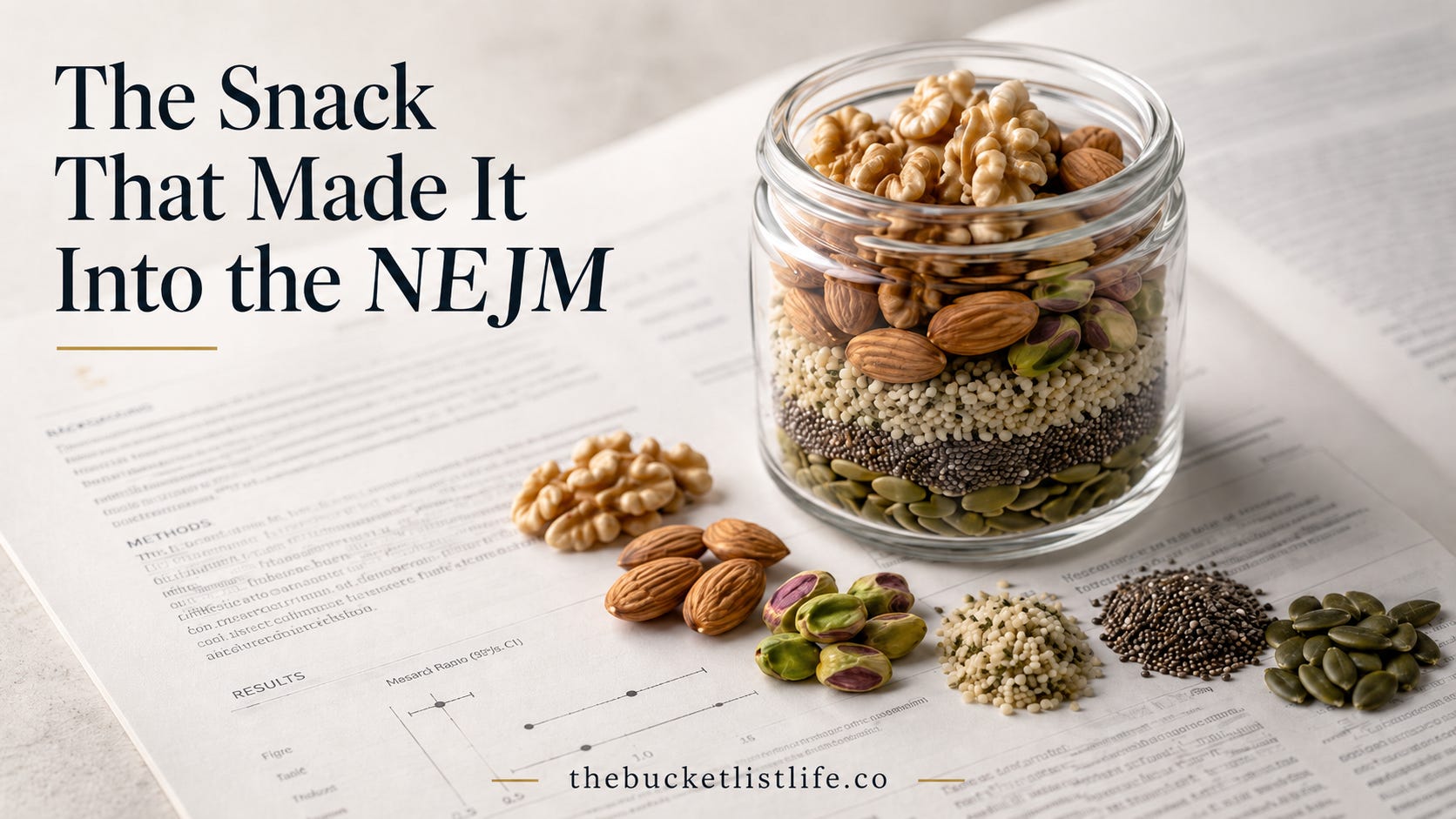
In 2013, researchers at Harvard published a study in The New England Journal of Medicine that tracked ~119,000 men and women for over two decades and asked a simple question: does eating nuts regularly affect how long you live?
People who ate nuts every day died at a 20% lower rate than those who ate none.
The pattern held across heart disease, respiratory diseases, and cancer. The more frequently people ate nuts, the lower their mortality.
This wasn’t a small study. It was decades of data from the Nurses’ Health Study and the Health Professionals Follow-Up Study — two of the most rigorous long-term cohorts in nutritional epidemiology (the study of how dietary patterns relate to health outcomes in populations). And it ran in the NEJM, which doesn’t publish nutrition studies unless the evidence is exceptionally strong.
I eat an evolving nut and seed mixture every morning. One important caveat before the recipe: this is observational data, not an RCT (randomized controlled trial) the gold-standard of scientific research. It tells us that daily nut eaters live longer, but it cannot prove the nuts are the cause. People who eat nuts daily may just exercise more, smoke less, and eat better overall.
However, the findings have been repeated consistently across multiple independent studies on multiple continents, and the mechanics of it — better cholesterol numbers, less inflammation, more stable blood sugar — are well-established.
With that in place, here’s what I currently eat every day.
The Mix
Every Monday morning, I assemble the week’s worth of mixture split into individual mini-jars kept in the fridge. It takes about four minutes.
One warning: nuts are very high in calories. These amounts are tailored to my own weight-loss plan, so nosh accordingly.
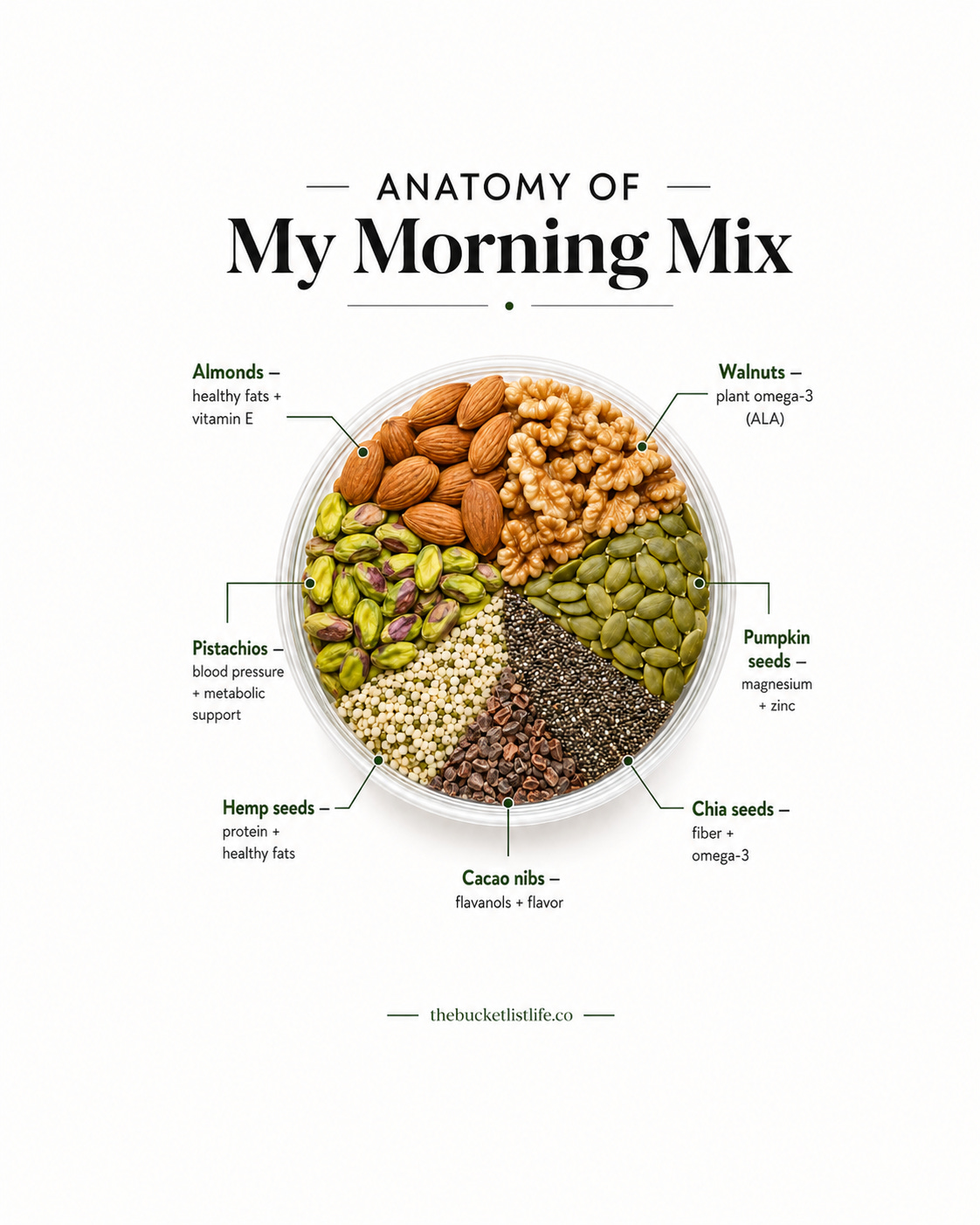
6 almonds. The most-studied nut for LDL reduction, with consistent findings across multiple independent meta-analyses. A 2019 Tufts University meta-analysis found almond consumption reduced LDL by roughly 6 mg/dL and total cholesterol by nearly 11 mg/dL.
4 walnut halves. The only common tree nut with meaningful alpha-linolenic acid (ALA) — the plant-based omega-3. If I had to keep only one ingredient in this mix, it would be the walnuts.
6 raw pistachios. A 2014 randomized trial found that daily pistachio eaters had lower blood pressure and better circulation than the control group. A 2015 follow-up found pistachios also lowered total cholesterol and triglycerides.
1 tsp pumpkin seeds. Zinc, magnesium, and phytosterols in a small package. The cost of adding a teaspoon to a daily bowl is essentially zero.
1.5 tsp hemp seeds. Contain all nine essential amino acids — and a favorable omega-6 to omega-3 ratio of roughly 3:1 (House et al., J Agric Food Chem, 2010).
1 tsp chia seeds (pre-soaked separately, stirred into the yogurt bowl). More ALA, soluble fiber that slows glucose absorption, and a gel-like coating that slows digestion. I pre-soak mine in kefir then go for a sunrise walk. Don’t skip the soaking — these seeds absorb a lot of liquid, so people with swallowing issues should be especially careful consuming them dry.
1 tsp cacao nibs (stored separately). The COSMOS trial — a randomized study in 21,000+ adults — found that cocoa flavanol supplementation reduced cardiovascular death by 27%. I include the nibs for the flavanols and the flavor, though I often forget to add them because I’m not very bright.
The Protocol
Sunday morning I measure one day’s worth of each ingredient into seven small glass containers. Each mixture portion goes directly into my daily yogurt bowl. Total active time: four minutes. Cost per day: under a dollar.
IMPORTANT FINAL NOTE: The health benefits nuts come from daily consumption. Whatever form this takes for you, the goal is every day, not a handful when you remember.
Supportive Science
Bao Y, et al. Association of nut consumption with total and cause-specific mortality. N Engl J Med. 2013;369:2001–2011.
Guasch-Ferré M, et al. Nut consumption and risk of cardiovascular disease. J Am Coll Cardiol. 2017;70:2519–2532.
Sauder KA, et al. Pistachio nut consumption modifies systemic hemodynamics. J Am Heart Assoc. 2014;3:e000873.
Sauder KA, et al. Effects of pistachios on the lipid/lipoprotein profile, glycemic control, inflammation, and endothelial function in type 2 diabetes. Metabolism. 2015;64:1521–1529.
House JD, Neufeld J, Leson G. Evaluating the quality of protein from hemp seed (Cannabis sativa L.) products through the use of the protein digestibility-corrected amino acid score method. https://pubs.acs.org/doi/10.1021/jf102636b.
Sesso HD, et al. (COSMOS trial). Effect of cocoa flavanol supplementation for prevention of cardiovascular disease events. Am J Clin Nutr. 2022;115:1490–1500.
sounds yummy