

THE BUCKET LIST LIFE | Science-backed habits for a longer, healthier, richer, happier life — from the man who invented the Bucket List.
THE STORY
Three of my closest friends from high school have ended up scattered across the country. One has lived on the West Coast for decades. We see each other rarely — once a year if we’re lucky, but recently he was back East, and so two of us traveled to meet him. We found a park and spent a few hours doing what old friends do: talking, laughing at stories heard and told a hundred times, and catching up on each other’s lives in the way that only really happens in person.
My older son came with me. On the drive home, I explained that these friendships matter to me as much as any in my life. Even though my friends and I connect a scant handful of times a year — we pick up exactly as we left off, as if we’d seen each other yesterday. What I didn’t say — because I still couldn’t find the language for it — was that I always feel physically different after seeing them. Not just good, but better, lighter, in some way that runs deeper than mood.
I’ve always wondered if that feeling was real. What I found, when I started actually looking into the science, is not what I expected — and, as it turns out, it surprised some of the most credentialed experts in the longevity field as well.
THE SCIENCE
Last week I watched a conversation between Dr. Rhonda Patrick (her YouTube channel is fantastic) and Dr. Steve Horvath — the researcher who built the original Horvath epigenetic aging clock, still considered one of the most accurate measures of biological age ever developed. They covered two and a half hours of longevity science: caloric restriction, GLP-1 drugs, omega-3s, exercise thresholds, vegetables versus everything else. When the conversation got to social connection, Horvath described a recent study by researchers at Cornell and Harvard as the biggest surprise he’d encountered in the last six months.
A Harvard researcher named Laura Kubzansky had collaborated on a study to measure whether social connection affects biological aging at the DNA level.
Could having good friends end up written into the chemistry of your DNA?
Horvath didn’t think the connection was close enough to even bother testing. She measured it anyway. The result: the GrimAge clock — one of the best DNA-based tools scientists have for estimating a person’s risk of dying earlier or later than expected, validated across studies involving tens of thousands of people — which showed a significant reduction in biological aging among people with rich, sustained social connections. The pattern showed up across every aging test they ran, especially the ones most closely tied to lifespan. The clearest takeaway was that strong social connections appeared to be linked with slower biological aging.
The paper, published in September, 2025 in Brain, Behavior and Immunity — Health by Anthony Ong, Frank Mann, and Laura Kubzansky, drew on 2,117 adults from the long-running Midlife in the United States (MIDUS) study. The researchers measured what they called “cumulative social advantage” — a composite of connection across family, friendships, community, and emotional support, built across a lifetime. Their conclusion:
People with deeper, more sustained social networks weren’t just emotionally healthier. They were biologically younger.
The mechanism isn’t mysterious. When you’re chronically isolated over time, cortisol (the body’s stress hormone) stays elevated. Sustained higher cortisol drives systemic inflation, impairs immune function, disrupts sleep and raises cardiovascular risk — the same cascade that accelerates cellular aging.
The opposite to isolation is meaningful social contact. When you’re with people you trust, your brain releases oxytocin, which dampens the inflammatory cascade. The body reads genuine connection as safety — and safety as an instruction to stand down from the metabolically expensive maintenance of threat response. That’s not a metaphor for feeling good. It’s a description of what’s happening at the cellular level.
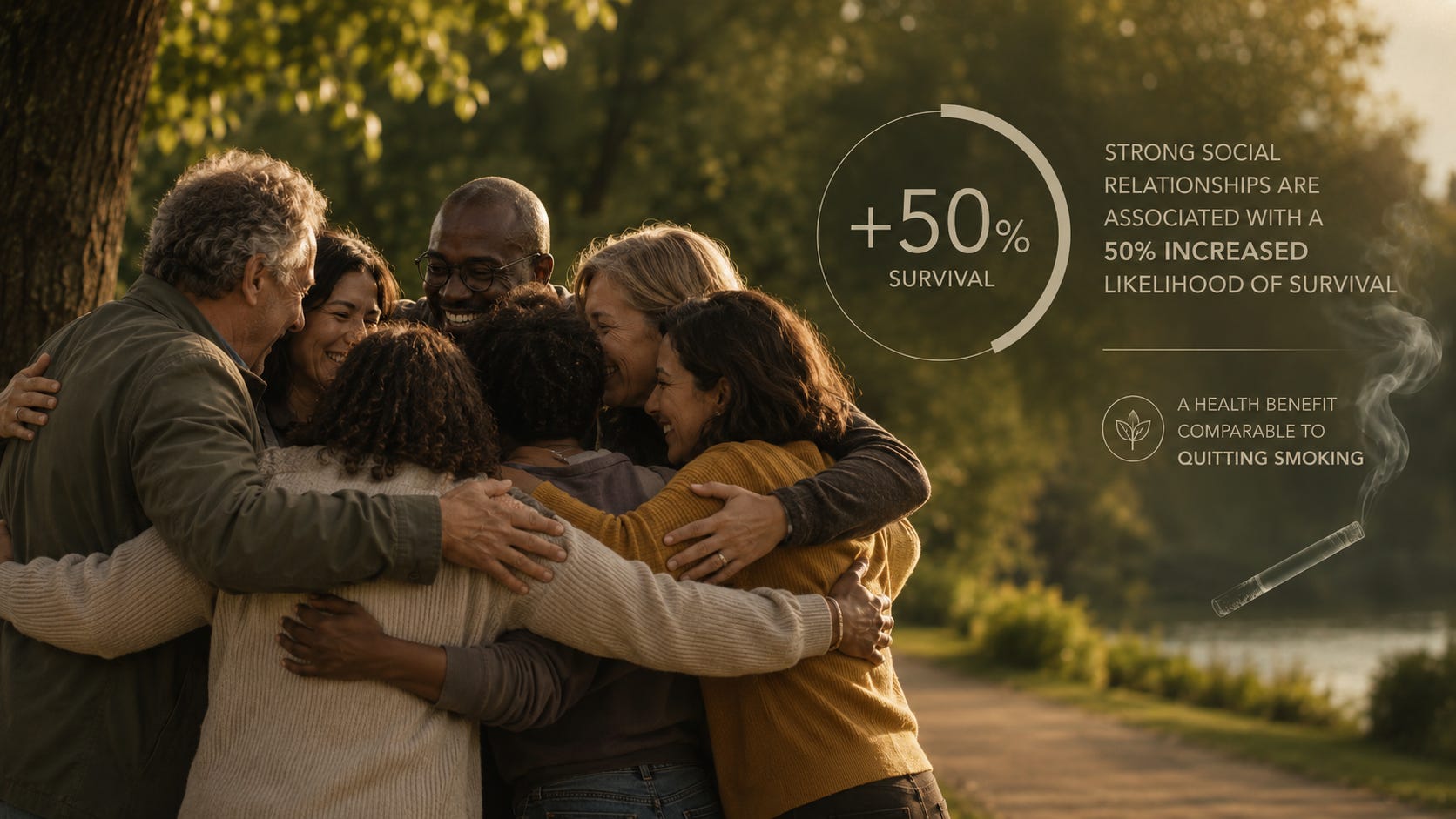
A 2010 meta-analysis by Julianne Holt-Lunstad covering 148 studies and more than 308,000 people found that:
Individuals with strong social relationships had a 50% increased likelihood of survival — as strong of a benefit to human health as quitting smoking.
In 2015, a follow-up analysis of 3.4 million people found that social isolation and loneliness increase the risk of premature death by 26–29%.
The U.S. Surgeon General’s 2023 advisory framed it plainly: lacking social connection increases your risk of early death to a degree comparable to smoking fifteen cigarettes a day.
A 2025 paper in the Journal of the American Geriatrics Society following more than 2,200 adults aged 60 and older over four years found that high social engagement was associated with a 42% lower risk of death.
The Harvard Study of Adult Development, the longest-running study of adult life ever conducted, has tracked thousands of people across 88 years and arrived at one of the simplest findings in all of medicine:
The people most satisfied in their relationships at age 50 were the healthiest at age 80. Not the wealthiest. Not the most physically fit. The most connected.
THE BUCKET LIST CONNECTION
My friends from high school knew me before I became a professional version of myself — before the accumulated habits and losses and choices that shaped who I am now. They relate to an earlier version of me, uncurated, unperformed. I would argue that time with them isn’t just pleasant — it’s corrective.
The central argument of The Bucket List Life is that the list isn’t really about activities. It’s about the person you’re trying to be, and tailoring a life worth extending. These friendships are part of that infrastructure — not a reward for getting everything else right, but a biological component of what getting it right looks like. The epigenetic data now says so. The man who built the aging clock didn’t expect that finding. Neither did I.
So stop scrolling and call a friend!
WHAT I ACTUALLY DO
Honestly: not enough, and I’ve known it for a while.
What I haven’t done is treat this as a health behavior. I’ve treated it the way most people treat important things they assume will survive neglect — with casual good intentions and no real structure. Looking at the mortality data, that’s a mistake I’m done making. I’ve added a quarterly call with each of my closest old friends to my calendar, with a reminder to set at least one in-person meeting per year with each of them.
My other chance is community engagement. The Kubzansky study’s “cumulative social advantage” isn’t just about friendships. It explicitly includes community involvement as one of its four domains. A separate meta-analysis of 14 studies by Okun et al. found that:
Formal volunteering reduced mortality risk in adults over 55 by 24% after controlling for confounding factors.
Separate research tracking participants over multiple years found that sustained volunteering is associated with measurably lower C-reactive protein levels — a marker of the chronic inflammation that drives biological aging.
I have talked about wanting to volunteer for years, but never followed through. So, I recently signed up with a local organization that provides food support, early education, and social services to families in my area. I start next week.
STUDIES CITED
Ong, A.D., Mann, F.D., & Kubzansky, L.D. (2025). Cumulative social advantage is associated with slower epigenetic aging and lower systemic inflammation. Brain, Behavior, and Immunity — Health, 48, 101096. https://doi.org/10.1016/j.bbih.2025.101096
Holt-Lunstad, J., Smith, T.B., & Layton, J.B. (2010). Social relationships and mortality risk: A meta-analytic review. PLoS Medicine, 7(7), e1000316. https://doi.org/10.1371/journal.pmed.1000316
Holt-Lunstad, J., Smith, T.B., Baker, M., Harris, T., & Stephenson, D. (2015). Loneliness and social isolation as risk factors for mortality: A meta-analytic review. Perspectives on Psychological Science, 10(2), 227–237. https://doi.org/10.1177/1745691614568352
Office of the Surgeon General. (2023). Our epidemic of loneliness and isolation: The U.S. Surgeon General’s advisory on the healing effects of social connection and community. U.S. Department of Health and Human Services. https://www.hhs.gov/surgeongeneral/reports-and-publications/connection/index.html
Abugroun, A., Shah, S.J., Covinsky, K., Hubbard, C., Newman, J.C., & Fang, M.C. (2025). Low social engagement and risk of death in older adults. Journal of the American Geriatrics Society, 73(7), 2166–2175. https://doi.org/10.1111/jgs.19511
Waldinger, R., & Schulz, M. (2023). The Good Life: Lessons from the World’s Longest Scientific Study of Happiness. Simon & Schuster.
https://www.robertwaldinger.com
Okun, M.A., Yeung, E.W., & Brown, S. (2013). Volunteering by older adults and risk of mortality: A meta-analysis. Psychology and Aging, 28(2), 564–577. https://doi.org/10.1037/a0031519
Kim, S., & Ferraro, K.F. (2014). Do productive activities reduce inflammation in later life? Multiple roles, frequency of activities, and C-reactive protein. The Gerontologist, 54(5), 830–839. https://doi.org/10.1093/geront/gnt090