

“Take your life in your own hands, and what happens?
A terrible thing: no one to blame.”
— Erica Jong
For over a decade, there’s a better than decent chance I was walking around with a Group 1 carcinogen living in my stomach — a cancer-causing bacterium that got treated, but, despite a well-established protocol, never confirmed dead by anyone, including me.
The infection wasn’t the failure. And though my first instinct was to blame the doctors, that wasn’t it either. The failure was me. I didn’t know enough. More to the point, I hadn’t bothered to learn enough to ensure I was getting the proper treatment.
Story
It started with a routine endoscopy/colonoscopy back in 2010, otherwise known as an “Up and Down,” where flexible, fiber-optic scopes examine the bookends of your digestive system. For the record, it’s nowhere near as bad as it’s made out to be. I took this test early (age 40) due to symptoms of irritable bowel syndrome.
The American Cancer Society recommends that average-risk adults (those without a personal or family history of colorectal cancer, inflammatory bowel disease, or symptoms) begin regular screening at age 45 continuing through age 75, with colonoscopy, the most common option, performed every 10 years.
The surgeons removed a bouillabaisse of polyps from my colon and rectum, including, alarmingly, a precancerous lesion called a tubular adenoma. This was small enough (8mm) that the cause for concern was low, though it put me on a faster track to have repeat exams every three years.
This proved to be the right play when, during my next exam in 2014, they removed a 2cm adenoma which, left untreated, carried a meaningful mortality risk over a 10-20 year window. With colon cancer, the two ways to find out you have it are screening or symptoms — and by the time you have symptoms, the cancer is often advanced.
And yet, many people (some of my closest friends, you pea-brains know who you are) refuse to get tested, even though, as my surgeon likes to shout at the top of his lungs, “It’s a preventable f*cking disease!”
AND NOW A FEW FUN FACTS ABOUT COLON CANCER
In adults under 50, colorectal cancer death rates rose 1.1% annually beginning in 2005, pushing the disease from the fifth leading cause of cancer death in the early 1990s to the first in 2023.
Those born around 1990 are 2x as likely to get colon cancer and 4x as likely to get rectal cancer as those born in 1950.
A study of nearly 30,000 women under 50, published in JAMA Oncology (November 13, 2025), found that those with the highest ultra-processed foods intake had a 45% higher risk of developing precancerous polyps compared to those with the lowest intake.
Among Americans aged 1 and older, an average of 55% of total calories came from ultra-processed foods.
A meta-analysis of 66 studies found that overweight and obesity significantly increases colorectal cancer risk by 25-57%.
While the disease is curable at Stage I, it is frequently incurable at Stage IV, and yet, roughly 75% of colorectal cancer patients under 50 are diagnosed at an advanced stage. That statistic is largely because under-50s aren’t being screened, so it’s often caught too late.
The psychology of this is well-studied. Anticipated discomfort and embarrassment are the top-cited reasons people don’t screen, followed closely by the feeling that testing for the presence of disease is too much a reminder of our own mortality. Here’s the counterintuitive part: it isn’t general worry about cancer that keeps people away — people who worry more actually tend to screen more. It’s the specific dread of the result — the fear of a positive test — that predicts avoidance. Psychologists call this monitoring vs. blunting: “blunters” duck threatening information even when that information could save their lives.
Back to our story…
In addition to the polyp festivities in my colon, the endoscopy discovered a thriving colony of Helicobacter pylori, a fairly common bacterium, colonizing my stomach. It’s the kind of infection a doctor mentions in passing, so benign that, to this day, I don’t remember having it at all.
According to my records, I was given antibiotics and moved on with my life. I assumed “treated” meant “cured.” Turns out those are not the same word. Here’s where my story turns from bad luck into a missed step: confirming eradication isn’t optional — it’s the protocol.
The 2024 American College of Gastroenterology clinical guideline states that proof of H. pylori eradication is required in all patients at least four weeks after the completion of antibiotics. The reason is blunt: feeling better is a poor indicator of whether the bacteria are actually gone.
I felt great. I never had the confirmation test. Guess what happened next…
A full thirteen years later, a subsequent “Up and Down” again showed H. pylori infecting my stomach. I’ll never know for certain whether I cleared it the first time and got reinfected, or whether I’d been carrying it for over a decade. I’m hoping for the former, as I’ve since learned that the International Agency for Research on Cancer classified H. pylori as a Group 1 human carcinogen (meaning there’s sufficient evidence from studies to show that the agent causes cancer) back in 1994, putting it in the same tier as tobacco and asbestos.
It is considered the primary driver of gastric cancer, implicated in roughly 80–90% of cases. I don’t want to be alarmist — while the infection roughly sextuples the relative risk of non-cardia stomach cancer, the absolute lifetime risk for most infected people stays in the low single digits.
Round two: another course of antibiotics. And here’s the part where I’m truly an idiot — I almost made the exact same mistake again. The reflex to take the pills and move on is that strong.
This time I caught myself. Well into the research phase of my “Selfaissance”, I read up on the infection and discovered the full protocol.
I called up my GP and asked him to prescribe a urea breath test specifically to confirm H. pylori eradication. There was a beat of hesitation, a little “do you really need that?” energy on the phone. I held my ground and explained my reasoning, citing the clinical guideline. We ran it. This time it came back clean.
So the ending is good. But sit with the middle of that story for a second: there is a real possibility I hosted a known carcinogen in my gut for thirteen-plus years because the simplest possible follow-up — a test that takes twenty minutes and involves blowing into a bag — never got ordered, despite being an established part of the treatment.
This raises the obvious next question — what else have we missed?
I have enormous respect for the years of training and the (often miraculous) expertise our physicians bring to the table — expertise none of us could begin to replicate by reading studies in a coffee shop or pounding the table on Substack.
But respect and deference are not the same thing.
You wouldn’t hire an architect to design your dream home without poring over the blueprints, asking questions, and making modifications to suit your way of life. The expert brings expertise you don’t have, but you’re the one who has to live there.
A good GP will ask if you have any questions — a good patient will have some.
So the blame is mine because I never thought to ask. I wholly deferred the care of my health and life to someone else. Never again.
Building the Playbook
Last year, I logged into the portals for every medical system I could remember being a patient of. Some of my tests and treatment results were easy to get; others required phone calls and repeated explanations that neither I, nor anyone I know, still has a fax machine.
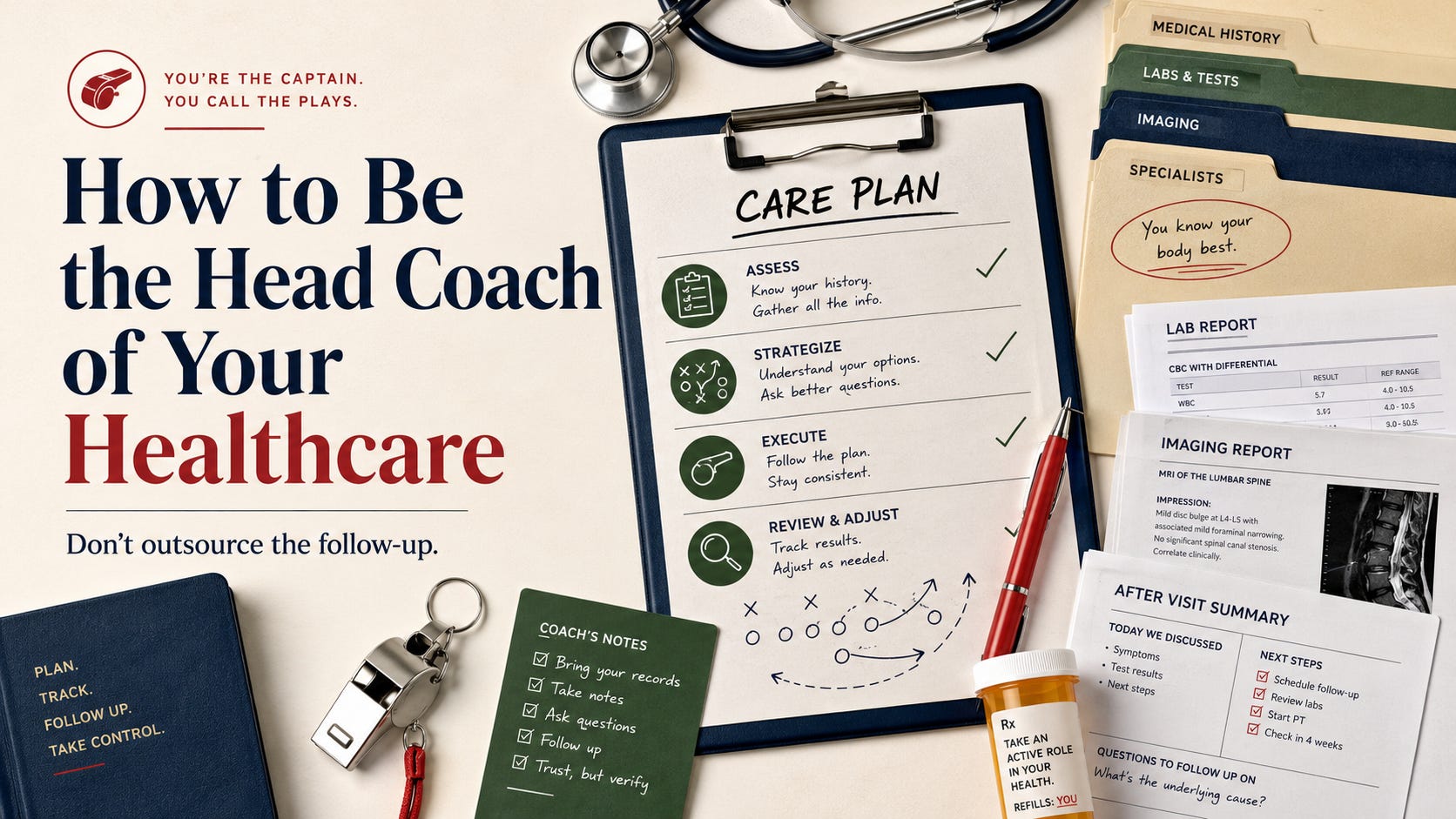
A few weeks and many trips to the mailbox later, I had a folder in my documents cloud that held as much of my medical history as I could cobble together. I keep the folder organized as follows:
Medical History
Lab results
Imaging reports
Diagnoses & Procedures
Prescriptions
Visit Summaries
Research
Now, after every medical visit, for any reason, I ask for a printed copy of the “After Visit Summary” and any follow-up labs or testing. I use a scanner app on my phone. Everything goes into the folder.
I have a standing check-up every 6 months, but this is because of my unique medical history and elevated risk factors (history of AFib, medications for blood pressure and cholesterol, history of GI polyps, history of being a fat ass and current weight-loss regimen).
For most people, annual check-ups are appropriate, depending on age and risk factors, although (and this is super-interesting) several medical bodies, including the Society of General Internal Medicine (SGIM), explicitly advise against the routine annual complete physical for low-risk asymptomatic adults, citing evidence of harm from incidental findings that trigger unnecessary testing. Talk to your doctor. Ask questions about scheduling for your specific situation.
A month before each appointment, I call my GP and ask what tests he’d like me to have before our meeting. I want to walk in with fresh numbers and have something real to discuss beyond the physical exam.
Then I use AI as the analyst sitting on top of that file. Before a scheduled checkup, I’ll feed it my entire history and latest labs, then ask a specific question:
“Based on everything in this folder, what are the major areas of concern, and what are the questions a world-class physician would want me to raise in my next meeting with them?”
AI gets things wrong — sometimes confidently and embarrassingly wrong — so I treat its output as a question generator, never a diagnosis. But it’s extraordinary as a tool for spotting trends across years of data and surfacing the right questions to ask — something no rushed appointment can do for me.
There are also valid privacy concerns with using AI in this fashion, and everyone should do their own research to determine their comfort levels. I’ll do a full post about working with AI and the “instructions” prompts I’m learning to use to (hopefully) manage privacy and efficacy.
I take the AI’s flagged concerns and research them for myself. I pick the ones that concern me and ask my doctor what he thinks. In the end, I walk out with a better sense and command of my current health, and always a visit summary to go into the records.
My gastrointestinal surgeon just retired. No more shouting. I’m due for my latest Up and Down, so I researched the best GI specialist in my area who’s covered by my insurance, and has treated patients with my history. When I go in for my consult, I’ll bring a document summarizing my entire GI history with a link to a Dropbox folder where they can download every report. I’ll ask questions and get a visit summary.
More and more, I’ve been using versions of this process in other parts of my life. It’s been a game changer for some aspects, wholly ineffective in others. Either way, I like that it forces me to question the way I approach things, and to learn about how my body, mind, and life work in ways heretofore taken for granted.
And, please. For the love of yourself, and your loved ones, and all of the adventures still waiting on your bucket list… If you’re 45 or over —
“Get a f*cking colonoscopy!”
Studies Cited
American Cancer Society. “Colorectal Cancer Screening Guidelines.” cancer.org. — average-risk screening begins at 45; colonoscopy every 10 years.
Siegel RL, Jemal A, et al. “Leading cancer deaths in people younger than 50 years.” JAMA. 2026;335(7):632-634. Full text via institutional access. Free secondary coverage: Becker’s Hospital Review / ACS press release. — CRC deaths in under-50s rose 1.1%/yr since 2005; now the leading cause of cancer death in this group.
Siegel RL et al. “Colorectal Cancer Incidence Patterns in the United States, 1974–2013.” JNCI. 2017;109(8):djw322. — those born ~1990 face 2x colon and 4x rectal cancer risk vs. those born ~1950.
Wang C, Du M, Kim H, et al. “Ultraprocessed Food Consumption and Risk of Early-Onset Colorectal Cancer Precursors Among Women.” JAMA Oncology. Published online November 13, 2025. doi:10.1001/jamaoncol.2025.4777 — 45% higher risk of conventional adenomas in highest vs. lowest UPF quintile (AOR 1.45; n=29,105).
Williams AM, Couch CA, Emmerich SD, Ogburn DF. “Ultra-processed Food Consumption in Youth and Adults: United States, August 2021–August 2023.” NCHS Data Brief No. 536. August 2025. doi:10.15620/cdc/174612 — 55.0% of total calories from UPFs among those aged 1+.
Ungvari Z, Fekete M, Varga P, et al. “Overweight and obesity significantly increase colorectal cancer risk: a meta-analysis of 66 studies revealing a 25–57% elevation in risk.” GeroScience. 2024. doi:10.1007/s11357-024-01375-x — pooled HR 1.36 overall; 1.57 men, 1.25 women.
Miller SM. “Monitoring versus blunting styles of coping with cancer influence the information patients want and need about their disease.” Cancer. 1995;76(2):167-177. — origin of the monitoring/blunting framework (Miller, Fox Chase Cancer Center).
Kelly KM, et al. “Colorectal cancer information avoidance is associated with screening adherence.” J Behav Med. 2024. doi:10.1007/s10865-024-00482-6 — defensive CRC information avoidance predicts lower screening.
Helicobacter and Cancer Collaborative Group. “Gastric cancer and Helicobacter pylori: a combined analysis of 12 case-control studies nested within prospective cohorts.” Gut. 2001;49(3):347-353. doi:10.1136/gut.49.3.347 — pooled OR ≈ 3.0; RR ≈ 5.9 when measured ≥10 years before diagnosis (the authors’ “best estimate”).
IARC Working Group. “Schistosomes, Liver Flukes and Helicobacter pylori.” IARC Monographs Vol. 61, 1994. — H. pylori classified Group 1 carcinogen.
Chey WD, Howden CW, Moss SF, et al. “ACG Clinical Guideline: Treatment of Helicobacter pylori Infection.” Am J Gastroenterol. 2024;119(9):1730-1753. doi:10.14309/ajg.0000000000002968 — test of cure required in all treated patients ≥4 weeks post-therapy.
IARC Helicobacter pylori Working Group. “Helicobacter pylori Eradication as a Strategy for Preventing Gastric Cancer.” IARC Working Group Reports No. 8. Lyon: International Agency for Research on Cancer, 2014. — H. pylori as primary driver of ~80% of gastric cancers.
always good stuff to be thinking about, when transitioning to a new way of taking care of oneself. excited to see where you go next on the journey.
Love reading about your sovereignty with doctors and AI. You gather info and decide what’s right for you. I learn a lot reading your essays. Thanks for taking the time to walk it all out, Justin.