
Over the past year, I’ve pored over countless studies and papers, articles and videos chasing the (often elusive) truth about the best research and practices for living a long and healthy life. In short: SCIENCE.
Here’s the short version of what it’s bought me: I’ve naturally lost over 70 lbs – with, sadly, many more to go. My sleep works again. My blood markers have come down. My attention span came back. And somewhere, in the middle of all that, I repaired my marriage, started two companies, and wrote half of a novel. Oh yeah, and this here Substack.
No magic bullets. No GLPs or TRTs or LMNOPs. No quick fixes. Just a collection of habits and shifts in my daily life, based on the collected research of folks much smarter than I could ever hope to be.
“I hope you live a life you’re proud of...
If you’re not, I hope you have the strength to start all over again.”
— The Curious Case of Benjamin Button
screenplay by Eric Roth
It’s more than a tad surreal when you accidentally coin a phrase that enters the global vocabulary. People use the expression every day — at dinner tables, hospital rooms, first dates and eulogies — but have absolutely no idea you exist. When they were younger, I told my kids that they should charge a quarter to anyone they heard using the term — they looked at me like I was insane. That hasn’t changed.
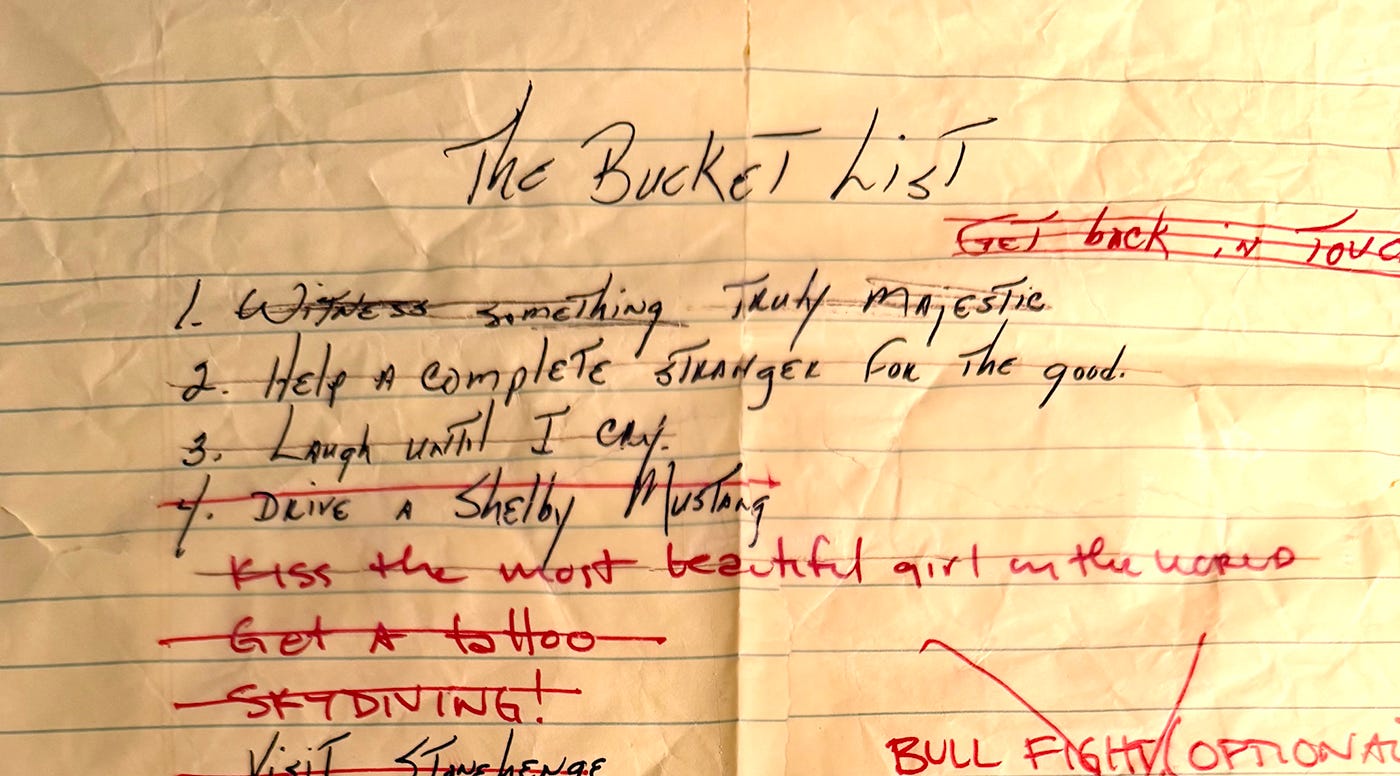
Several decades ago, I wrote the screenplay for the film THE BUCKET LIST. Before that, I was just a broke bartender with a film degree. In an early-morning fit of self-loathing (over my lack of any meaningful progress on any meaningful front) I wrote down a list of “Things To Do Before I Kick The Bucket,” which I shortened to “Justin’s Bucket List.”
A year later I had an idea about how to make it a movie, and that list became a script. Somehow that script found its way to the late, great Rob Reiner, director of classics including Spinal Tap, Stand By Me, When Harry Met Sally, and A Few Good Men. Somehow the script became a film starring Jack Nicholson and Morgan Freeman, and the rest is history.
Believe it or not, the best part of the adventure wasn’t the Hollywood part at all. Not even close.
In the decades since, I’ve received letters and e-mails from people who’ve been inspired to climb mountains (literal and figurative) after seeing the film.
I’ve been lucky enough to meet incandescent people like the amazing Alice Pyne, who, famously, turned her bucket list into a blog and chased the life of her dreams before losing it at age 17.
I’ve had countless conversations with people telling me how they took the idea and changed their lives. Next to loving someone and having them love you back, making even a tiny, positive difference in someone’s life has to be the greatest feeling. I’ve had a wonderful and lucky career, but no professional success has ever nourished me in the way that these experiences have.
Writing THE BUCKET LIST certainly changed my life for the better.
Until it didn’t…
At the suddenly sagging age of 54, it dawned on me—what had long been clear to everyone around me—that the life I was living no longer resembled the life I had planned. What’s more, said life was going to be a lot shorter and far less vibrant than assumed if I didn’t make some (aka many) changes.
Physically, my body was unrecognizable, its bulging hills and vales eternally hidden beneath over-sized shirts and baggy shorts. My shoes were slip-ons (shoelaces were too labor-intensive) and I had just had surgery to repair my second torn bicep, three years removed from heart surgery to stop my burgeoning atrial fibrillation (irregular heart fluctuations) brought on by a mostly sedentary, screen-addled, sleep-deprived, hyper-caloric, modern American lifestyle.
My once-boundless work ethic had evaporated—more than an hour of “work” was enough to send me running into the soft embrace of my iPad, while my attention span had dwindled into capsule-sized, YouTube shorts and Reddit posts. Thanks to my tech-addiction and several years of an ill-advised medication to combat anxiety, I had become Ted Lasso’s attention-deficit goldfish, not in the good way.
Socially, the idea of a dinner party with neighbors or expending more effort than an email or, god forbid, a phone call to maintain lifelong relationships with friends and family had become an allergy. Why talk when you can text? Why text when you can emoji? 🍆
Financially, I went from a very comfortable tax-bracket and a decades-long self-education in investing, to a lazy, undisciplined routine of over-spending and under-saving that applied pressure to my bank accounts and tension to my marriage. In short, I had become, as I’ve come to call it:
OVERFED.
After a ten year estrangement, my brother and I met up at a NY Yankees game to see about restarting our relationship. Though only two years younger than me, he was lean and spry with ruddy cheeks and cords of veins on his arms. He talked of all the ski trips he’d been on, playing sports with his son, the extensive travel he did for work. It was great to see him and even better to see him doing so well.
But, as I drove home, I couldn’t help but compare his vigor to my torpor. His muscle to my man-boobs. He is as close to a physiological match to me as exists on Earth, and thus living proof that my decisions and (in)actions alone had led me to this stodgy point in my life.
The next morning, I input some health data into my Stupid AI and asked it to tell me what I was most likely to die of in the next ten and twenty years. The answer scared the crap out of me.
I immediately asked it to recommend a list of the best calorie-tracking apps. I downloaded one and pre-paid the annual subscription fee. I ate a sugar-packed protein bar for breakfast, wondering how many minutes it would be before I was hungry, and sat down to write, “Justin’s Second List of Things to Do Before I Kick The Bucket”.
It worked once, right?
After twenty years as a professional Hollywood screenwriter, if I have developed any semblance of a superpower it’s that I love, love, love to research. Seeking authenticity in my writing, I have been down countless rabbit holes of scientific studies, Vatican documentaries, self-help books and medical research facilities. I have spoken with cardiologists, psychiatrists, dentists, life coaches, porn stars, writers, investment pros and even professional athletes. When it comes to storytelling, obscure truths are always more compelling than make-believe, if you’re dogged enough to sniff them out.
So I, and my fat ass, dusted off my curiosity of old and started digging. I became so obsessed that my other projects fell by the wayside.
James Clear’s wonderful “Atomic Habits” relates the story of Dave Brailsford, a performance coach brought in to help the flailing British cycling team. He employed a philosophy called “the aggregation of marginal gains.” By making a host of small 1% improvements in all facets of team life—more aerodynamic uniform fabrics, better pillows, more rigorous hand-washing—he lifted them to dozens of Olympic medals and Tour de France victories.
Minus any verifiable athleticism of my own, I’ve taken a similar approach by picking apart every facet of my life and looking for incremental opportunities to improve. Many seemingly great ideas fell away (looking at you natural silk dental floss), while a select few practices began to solidify into a routine.
Along the way, I ventured down innumerable false paths, chasing fad diets, magical supplements with sciency-sounding names, and videos of muscled Chads with sleeve tattoos and the prefix “Doctor” tenuously appended to their name.
As more and more conflicts arose in the deluge of information I was drowning in, I realized I needed a rubric to filter out the slop from actual, verifiable FACTS. I limited my focus to experts who have spent their lives, at the highest levels of science, researching their area of expertise.
This almost too easily ruled out chiropractors selling supplements as they pound the dinner table about the life-saving benefits of tallow, and doctors warning us about the deadly self-defense mechanisms of fruit (yes really). Instead, I focused on published, peer reviewed studies from Harvard, JAMA, and similar bastions of non-B.S., rigorous data from thousands of subjects.
So I locked myself away and read and watched and listened and experimented, until a daily framework began to emerge.
As to how I came to start this Substack, there’s a bit of a story there that hearkens back to that wonderful feeling you get from helping people.
My younger son started a vending machine business at the town swimming pool – we’re partners but he’s definitely the boss. Our first year was full of lessons as our bulletproof, top-of-the-line machine broke down repeatedly.
During one of the many service visits, the technician, an elderly, affable chap named Matt, limped from his truck to the machine. He told us about the three knee replacements he’d had, none of which had worked, and lamented that, after 50 years owning, operating and repairing vending machines, he was finally going to call it quits. He was in constant, significant pain, but in 70 years had never taken any painkillers and wasn’t about to start now.
What’s more, every male member of his family, Matt explained, had died suddenly from “The Widow Maker,” a severe blockage of the major coronary artery that frequently results in sudden death. He had a similar blockage, but was unable to have corrective surgery due to the blood thinners he was taking for his knee.
I had been using AI to build a health chronology for myself, and had discovered a few glaring, potentially deadly, gaps in my treatment – something we’ll discuss at great length next week. I asked Matt if he minded if I put some of his information into ChatGPT to see what came up. Over the next hour, as he disassembled then reassembled the machine, I did a deep dive about knee replacements that “didn’t take” and asked for suggestions.
(As an aside, I am all for using AI as a research or memory tool, but assiduously check every fact myself, and do all of my own writing.)
When we were done, Matt had the name of two doctors who specialized in failed knee replacements and a word-for-word script to use when calling them. I texted him the information as we helped carry his tools back to his truck. He said he’d think about following up, but didn’t like New York City, and didn’t trust the doctors there. Oh well.
My son and I agreed that Matt would never make the call, but were surprised a week later when he texted that he’d called the doctor, read the script, and, after some back and forth, had been moved to the top of the surgery list. “The surgeon feels confident that he can get me back to 85% normal usage. Maybe 90% in time.” Being stubborn, Matt pushed the surgery date to this summer (2026), when it would, “Interfere less with work,” and thanked me.
When I showed the messages to my son, 12, he was beaming. We talked about how I’d learned how important it is to, “Quarterback your own life, especially your health,” and agreed that we’d follow up with Matt to see how his surgery goes. He said he was happy that we hopefully helped Matt, and I agreed.
Which got me thinking… And, it seems, writing…
My only rule is that everything here is something I’m actually using (or testing) on myself. I make no endorsement of any philosophy, diet, or brand beyond that. I’m not a doctor and nothing here is medical advice, just one man’s curiosity.
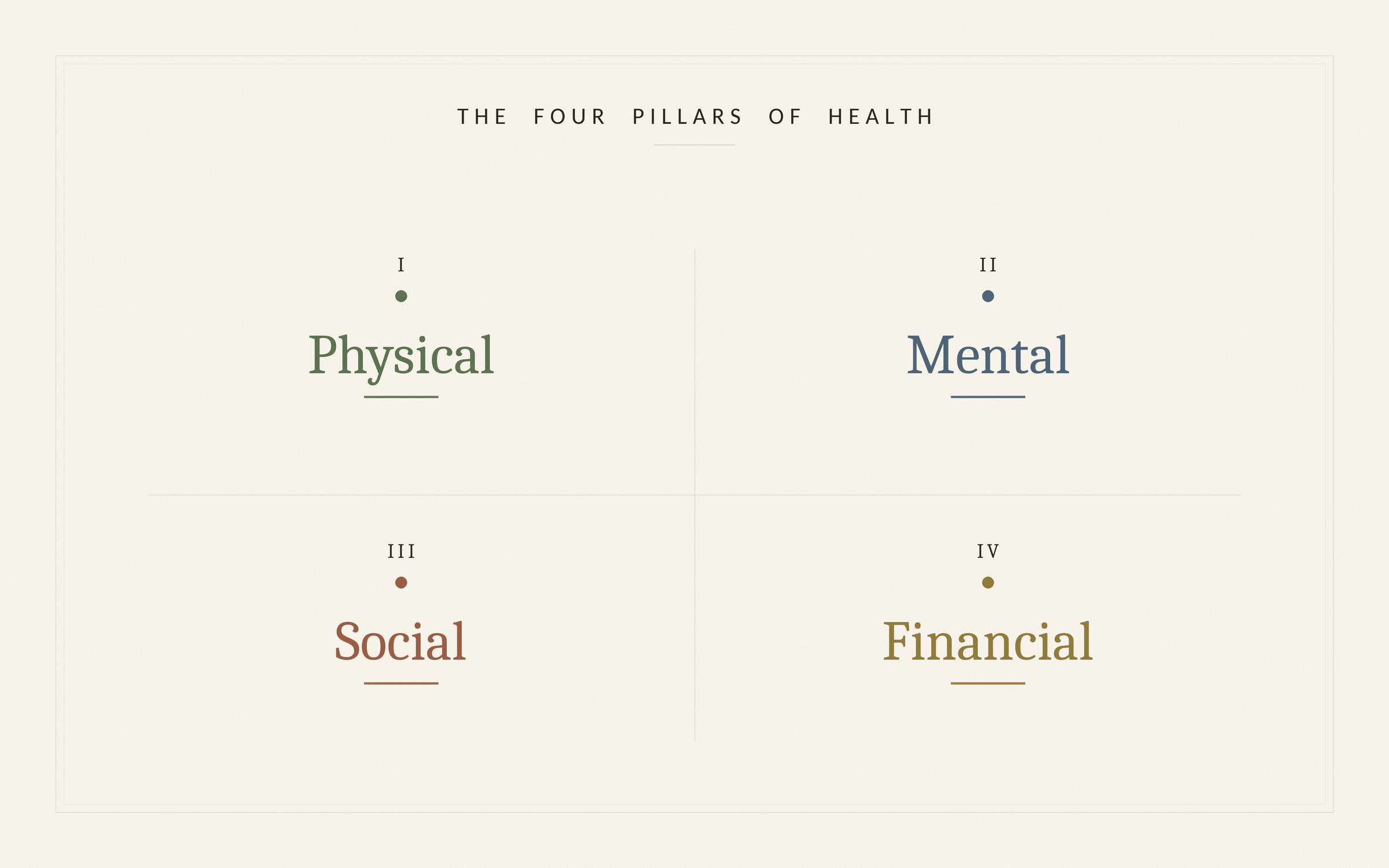
Since there’s more to life than our latest blood draw, this will gradually expand to encompass all facets of life. I’m looking to unearth everything that will help us improve foundations in all four pillars of health:
Chances are high that I will find newer and better options, and even higher that I will get some of it wrong. I actually love to be wrong–my wife tells me I’m an expert at it–because realizing you’ve been wrong usually means you’ve discovered what’s actually right.
I spend hours on this every day. You won’t have to. My game plan is to cough up two write-ups each week:
THE STACK - Tuesdays
A relatively deep dive on a component of my daily routine and the science behind it. Personally tested and explained in plain English (or as close as I can get). We’ll start in the morning and work our way through the day. We’ll write something called a “Red Eulogy” for ourselves (because thinking about death is super fun!) and interview top minds to answer eternal questions like, “What toothpaste should I use?” (spoiler alert: you should be using more than one).
FIELD NOTES - Fridays
A smaller look at something I’m digging into. A recent study. A product review. A “Wellness Bullshit Watch” debunking a viral trend, phony supplement or guru claim. Maybe even reader questions if anyone ends up following along.
I have no idea if this is going to work, but I’ve committed to spending at least the next year finding out. My life needs to change. I’ve started the process, but have quite a long way to go. Some days I have the strength to keep pushing, other days not so much. This is my accountability. It’s also very likely my mid-life crisis, so hop on in, the water’s warm.
If you’re still reading and, like me, you’ve felt the drift from living a life you’re proud of, then I’m betting you’ll encounter some things that will make you think, maybe even give you the strength to change something small, like, I dunno, your toothpaste.
A 1% adjustment might not seem like a lot, but, as we’ll discover together, it might just change everything about your life.
Great info. Good luck on your quest. I’m excited to follow along…
I’m a little embarrassed Justin bc I was about to say that the term “bucket list” put a damper on my “ adventure list”. ( I grew up shielded from the inevitable).
After reading this article, I’m on board to following along as you delve into how our lives can be significantly impacted by commitment to smart changes.
I agree with AI for research not writing. As Poirot says we need to exercise our “ little gray cells”.
PS
Great screenplay & film. I’m sticking to adventure list though.