

"Sometimes the most productive thing your brain can do is hold a book. And sometimes it's to hold nothing at all."
My previous article on sunrise walks got me thinking. The light, the sounds, the fresh morning air — all of it lands somewhere between meditation and medicine.
But there’s a thing I haven’t mentioned: I almost always have an earbud in one ear. A podcast. An audiobook. Something I’m “learning from.” I tell myself I’m stacking habits — getting my light exposure, exercise, and feeding my brain — and it feels productive. It feels efficient. I refuse to say “optimized” — that goes in the “retch” category with venti soy lattes.
But I’ve been wondering if listening to a book offers the same benefits as reading one. Would I be better off ditching the ear pod to envelop my ears in the dulcet sounds of early morning nature? Also, is reading a paper book better than digital?
Rabbit holes beckoned…
Right off the bat, I was fully surprised to learn that the case for reading is a longevity one. A 2016 Yale study tracked 3,635 adults over 12 years and found that people who read books for more than 3.5 hours a week were 23 percent less likely to die during the study period.
Book readers lived roughly 23 months longer than non-readers. Not magazine readers. Not newspaper readers. Book readers specifically.
In 2026, a study published in Neurology followed nearly 2,000 adults and found that those with the highest lifetime engagement in intellectually stimulating activities — reading and writing chief among them — delayed the onset of Alzheimer’s by five years and mild cognitive impairment by seven. The most engaged group had roughly 40 percent lower risk.
Naturally I wondered if audiobooks give us the same benefit. The truth is, we don't know — the longevity studies measured reading, not listening, so audiobooks weren't tested separately. However…
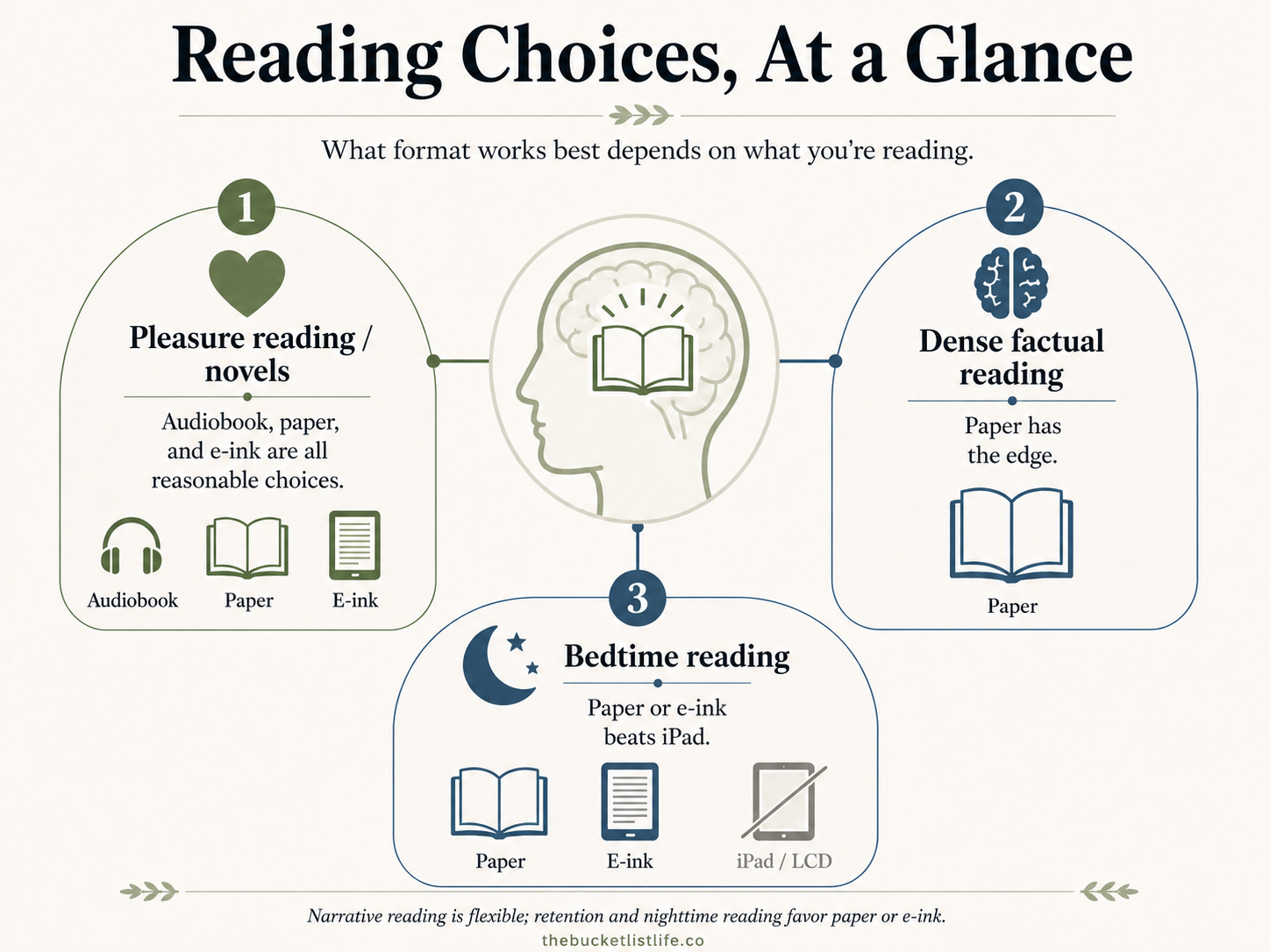
We do know that reading vs. listening comprehension appears roughly comparable for narrative material — books you read for pleasure.
A 2016 Bloomsburg University study found no significant differences in comprehension between audiobook listeners and e-reader users for a nonfiction narrative. But that study compared audiobooks to screens — not to paper.
A separate study by psychologist David Daniel found that students who listened to a podcast lesson scored nearly 30 percent lower on comprehension tests than students who read the same material in print.
VERDICT: For a novel on the beach? Audiobooks are just fine. For something dense with facts you actually want to retain? The physical page has the edge.
Then there's the screen question. A meta-analysis across 54 studies found that people who read on paper consistently outperformed those who read on screens in comprehension — a phenomenon researchers call the “screen inferiority effect.”
This effect was significant for expository/informational texts, but not for narrative texts.
And not all screens are equal. A Harvard-commissioned study found that e-ink (Kindle, etc.) displays produce two to three times less retinal cell stress than LCD (iPad, etc.) screens. And the circadian data is stark: Reading on an iPad before bed suppresses melatonin by about 50 percent and delays its onset by roughly 90 minutes compared to a paper book. E-ink doesn’t do this, because it reflects ambient light rather than blasting it into your eyes.
VERDICT: For a novel at the beach, or in bed at night? E-ink readers are just fine. For something dense with facts you actually want to retain? Once again, the physical page has the edge. Save the iPad for daytime videos or web browsing.
What I actually do…
Most mornings, I walk with one earbud in — a podcast or audiobook in one ear, the world in the other. I’m not giving that up, but every now and then, I leave the earbud out entirely. I let the tweety-birds and the wind and the silence do the work.
There’s good science behind that too — a concept called Attention Restoration Theory — and the short version is that nature’s quiet complexity recharges the exact cognitive resources you need to focus later. The earbud, even in one ear, blocks some of that.
For bedtime, I am committing here and now to ditch the iPad and read a book on my Boox e-ink tablet, for at least 20 to 30 minutes before sleep.
Incidentally, I chose this model because constantly reaching over to swipe the pages kept me awake. Boox has a Bluetooth device called the Tappy that lets me turn the page with just a small flex of my thumb. I’ve tried other brands with similar devices, but none worked flawlessly.
I also found a great tablet stand that attaches to my bedside table, setting it to the perfect, cock-eyed reading angle when my head is in sleep position on the pillow.
Consuming information in every available moment isn’t the same as learning. Sometimes the most productive thing your brain can do is hold a book. And sometimes it’s to hold nothing at all.
One thing I can say with certainty is that my brain is especially good at the latter.
STUDIES CITED
Bavishi A, Slade MD, Levy BR. “A chapter a day: Association of book reading with longevity.” Social Science & Medicine. 2016;164:44-48. doi:10.1016/j.socscimed.2016.07.014
Zammit AR, et al. “Association of Lifetime Intellectual Enrichment With Cognitive Decline and Incident Dementia.” Neurology. 2026. doi:10.1212/WNL.0000000000210434
Rogowsky BA, Calhoun BM, Tallal P. “Does Modality Matter? The Effects of Reading, Listening and Dual Modality on Comprehension.” SAGE Open. 2016;6(3). doi:10.1177/2158244016669550
Daniel DB, Woody WD. “They Hear, But Do Not Listen: Retention for Podcasted Material in a Classroom Context.” Teaching of Psychology. 2010;37(3):199-203. doi:10.1080/00986283.2010.488542
Delgado P, Vargas C, Ackerman R, Salmerón L. “Don’t throw away your printed books: A meta-analysis on the effects of reading media on reading comprehension.” Educational Research Review. 2018;25:23-38. doi:10.1016/j.edurev.2018.09.003
Harvard T.H. Chan School of Public Health / E Ink. “Effect of Displays on Human Retinal Pigment Epithelial Cells.” Journal of the Society for Information Display. 2023. doi:10.1002/jsid.1191
Chang A-M, Aeschbach D, Duffy JF, Czeisler CA. “Evening use of light-emitting eReaders negatively affects sleep, circadian timing, and next-morning alertness.” PNAS. 2015;112(4):1232-1237. doi:10.1073/pnas.1418490112
Berman MG, Jonides J, Kaplan S. “The cognitive benefits of interacting with nature.” Psychological Science. 2008;19(12):1207-1212. doi:10.1111/j.1467-9280.2008.02225.x