

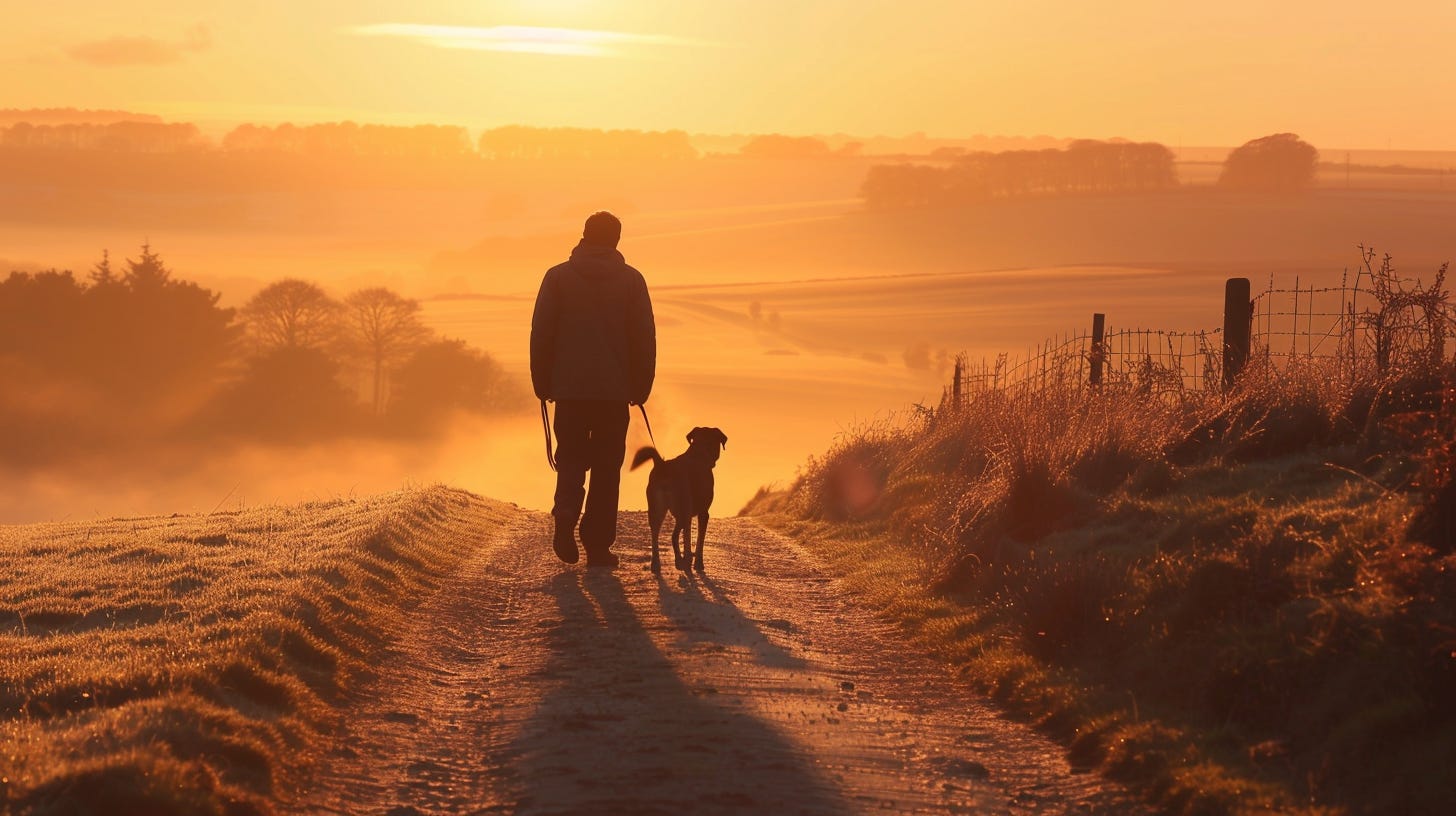
“Turn your face to the sun and the shadows fall behind you.” —Māori Proverb
MY SLEEP has always been a Jackson Pollock. Hectic. Chaotic. Chronic insomnia with a dose of sleep apnea managed with a mouth guard because I’m too big of a wuss to wear a CPAP. I’d fall asleep, or not, then wake up at 1 AM, 3 AM, 4:30 AM — staring at the ceiling, wrestling pillows, mind flailing, body exhausted but somehow wired. It wasn’t sleep. I was passing out for a few hours and calling it rest. For years.
I’d tried the usual litany. Melatonin. Magnesium. White noise. Sleep podcasts. Expensive mattress. “Cooling” pillows. Nothing stuck because none of it addressed the actual problem.
Then my friend — not a doctor, not a biohacker, just a guy who’d also been sleeping terribly for years — told me he’d started taking a walk to watch the sunrise every morning. Within days, he was falling asleep faster and staying asleep throughout the night. No supplements nor gadgets, just sunlight at the right time.
I thought he was out of his mind. But I was desperate enough to try anything, so the next morning I grabbed my dog’s leash and walked outside at dawn.
That was the beginning of the most significant health change I’ve made in this entire “Selfaissance.”
Thinking this all sounded super fringe-sciencey, I immediately burrowed my way through into a cavalcade of studies on circadian biology. As usual, I couldn’t have been more wrong — this is long-settled science.
Deep in the center of your brain, just above where your optic nerves cross, sits a tiny cluster of about 20,000 neurons called the suprachiasmatic nucleus — the SCN. Think of it as your body’s master clock.
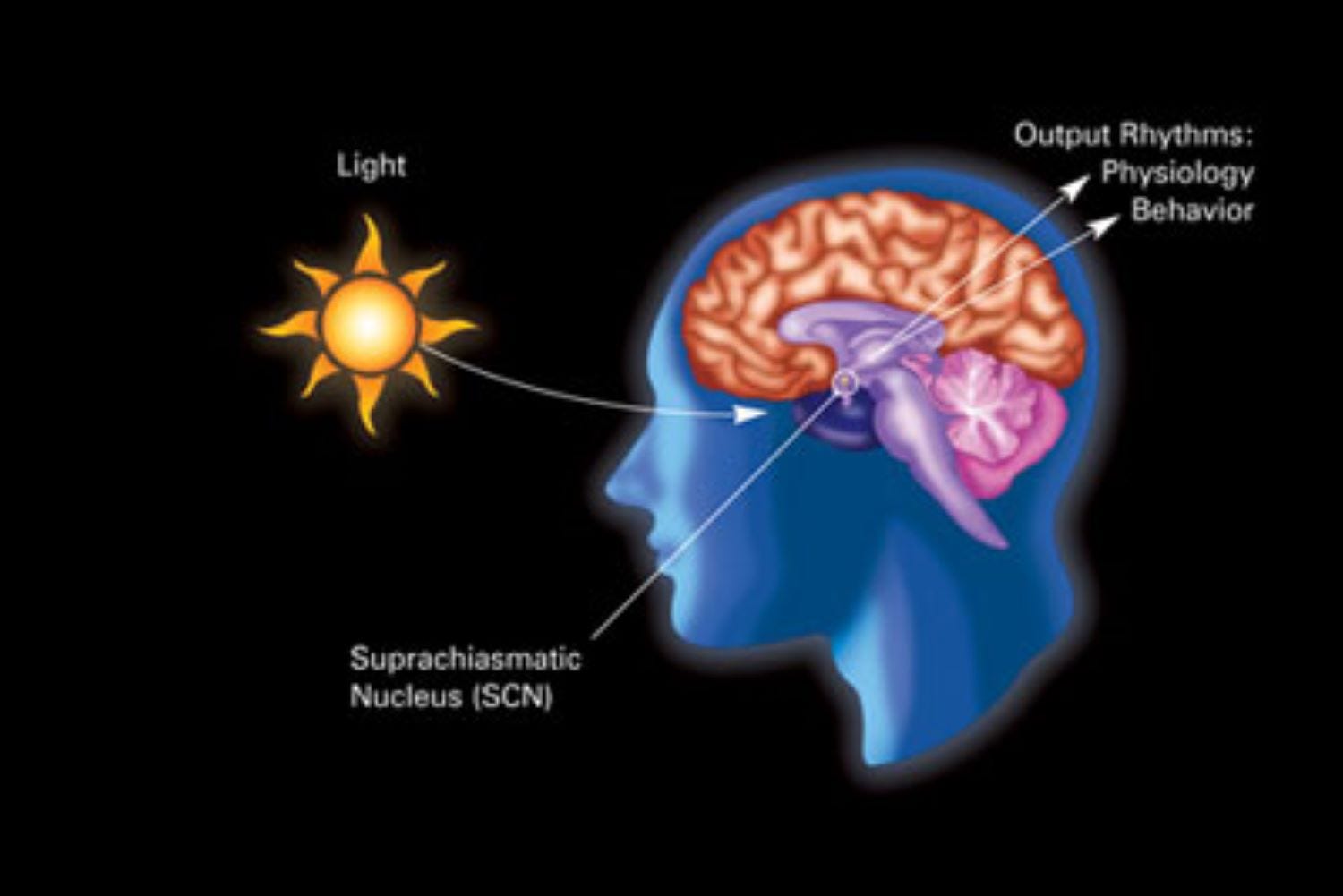
It coordinates when you feel alert, when you feel sleepy, when your body temperature drops, when hormones release, when your cells repair themselves. Every organ in your body takes its timing cues from this one tiny structure.
This clock is ancient. Not centuries old — hundreds of millions of years old. The basic genetic machinery that drives the SCN is found in virtually every mammal, and versions of it appear in organisms as simple as fruit flies. Evolution built this system long before anything resembling a human existed, and it’s been running with Swiss-like precision ever since.
Actually, that’s a lie. The clock doesn’t keep perfect time on its own. Left in total darkness, it drifts — running slightly longer than 24 hours. Every single day, it needs to be reset…
And the reset signal is light.
Our eyes contain specialized cells — only discovered in 2002 — that don’t help with vision at all. Their sole job is to detect the brightness and color of ambient light and transmit that information directly to the SCN.
For all of human history — all 300,000 years of Homo sapiens, and the millions of years of our ancestors before that — these cells have detected the bright, blue-rich light of morning, and told the clock: it’s daytime. Fire up the wake-up sequence. When the light dims and shifts toward the red-orange spectrum of sunset and (as our ancestors were accustomed to) firelight, the signal changes: day is ending. Begin the shutdown.
Thomas Edison—who incidentally called sleep a “criminal waste of time, inherited from our cave days”—patented the incandescent light bulb in 1879, and for the first time in the history of life on Earth, organisms could blast their retinas with bright, blue-spectrum light after sunset. Us humans have been doing it with gusto for the past 147 years, a nano-second of the 300 million years our internal clocks have been ticking.
The problem is simple: evolution doesn’t work that fast. We haven’t adapted yet.
The evolutionary biology of the SCN has been well-documented, going back decades. Meanwhile, the research on what artificial light does to our circadian system is damning and remarkably consistent.
A study published in the Journal of Clinical Endocrinology & Metabolism found that ordinary room lighting — the bulbs in our homes — shortened the body's internal representation of nighttime by roughly 90 minutes in 99% of participants. Not bright light. Not staring at your phone. Just being in a normally lit room in the hours before bed.
A second study from the same research group, published in the Proceedings of the National Academy of Sciences, compared the affects of reading on an iPad vs reading a printed book for four hours before bed. The iPad readers had their melatonin suppressed by 55%, their circadian clock delayed by more than an hour and a half, and they spent less time in REM sleep — the phase most associated with memory, emotional processing, and cognitive recovery. They also took longer to fall asleep and reported feeling groggier the next morning, even after eight full hours in bed.
Conversely, a 2025 observational study in BMC Public Health found that every 30-minute increment of morning sun exposure before 10 AM was associated with a 23-minute earlier sleep midpoint — meaning people who got morning sunlight fell asleep earlier and woke earlier, with better overall sleep quality.
None of this is controversial. It’s well-established biology. But most of us live as if it doesn’t apply to us — lights blazing until midnight, phones blasting our retinas in bed.
We evolved under conditions that no longer exist, and our sleep is paying the price.
After swan diving down far too many rabbity holes, here’s what I do…
I now wake up at the same time every morning. Consistency matters more than any specific hour — the clock needs a predictable signal. For me, that’s usually around 15-minutes before sunrise. At home, I wake automatically. If traveling, I set a backup alarm.
Within minutes of rising, I drink a full glass of water then take my eagerly waiting dog for a 30-minute walk. The destination is nearby hilltop where we can watch the sun appear over the horizon. I don’t wear sunglasses and I don’t fry my retinas staring into the heart of it. The point is to let the long-wavelength red and near-infrared light reach the cells in your eyes that set the clock.
This walk has become my daily anchor and is easily the single most impactful change to my life. No supplement, no device, no food hack has come close to the effect of morning sunlight on my sleep quality, and thusly, the quality of my daily life.
During the day, I get outside as much as possible. Natural light during daytime hours reinforces the signal. If I’m starting at a screen — which I usually am — it’s through medium-red-tinted glasses to cut down the blue light. When possible, I catch a few minutes of the sunset — the shift from blue-dominant to red-dominant light appears to help the transition.
After sunset, I try to wear my darker glasses. Everything I do at night — watching TV, working at my computer, moving around the house — I do through those lenses. They block the blue-spectrum light that would otherwise tell my clock it’s still daytime. I keep the house dim as well — drives my family crazy, but they’re slowly getting used to it.
At bedtime — between 9:30 and 10 as consistently as I can — I read on my iPad. I know I just talked about the study showing iPads suppress melatonin, but here’s the real life version: a reading light bright enough to see a book keeps my wife awake. So I use the iPad’s built-in shortcut that turns the screen fully red — eliminating the blue light entirely. It’s a compromise, not perfect, but it works. Nevertheless, I’m usually zonked within 10 minutes of laying down — a tectonic shift from my former hours of
I keep the curtains open. This was a change I resisted because I assumed darkness was essential for sleep — and it is, during sleep, for most people. But I live out in the country with minimal light pollution, and found that leaving the curtains open lets the earliest pre-dawn light wake me naturally without an alarm. My body is anticipating dawn because it can sense the light shifting. That alone tells me the clock is working.
And the results?
Since I started this protocol, my Apple Watch tells me that I’ve gained over an hour of average nightly sleep. The 1 AM and 3 AM wake-ups have largely disappeared, and when they come they’re short-lived. I fall asleep faster. I wake up feeling rested, not groggy or hungover.
An extra hour doesn’t sound like much until you do the math. That’s seven extra hours of sleep every week. Thirty hours a month. Three hundred and sixty-five hours a year — more than fifteen full days of additional sleep.
Leading an active, aspirational life requires a body and brain that properly recover overnight. You can’t hike the Inca Trail or write the great American novel or be consistently present with the people you love when you’re running on five hours of broken sleep. This is about functioning — and giving yourself enough years and enough good days to do the things that matter.
Sleep isn’t rest. It’s reconstruction. And the blueprint for how to do it has been running in our biology since before our species existed. You just have to stop jamming the signal.
Ra Optics makes both pairs of the tinted glasses I wear. They’re not cheap, and I’m not going to pretend they’re the only option. But they block significantly more blue light than the clear “blue blocker” lenses you see at the drugstore, and they’ve been part of my protocol since the beginning.
Studies Cited
Gooley JJ, Chamberlain K, Smith KA, et al. Exposure to room light before bedtime suppresses melatonin onset and shortens melatonin duration in humans. Journal of Clinical Endocrinology & Metabolism. 2011;96(3):E463-E472.
URL: https://pubmed.ncbi.nlm.nih.gov/21193540/Chang A-M, Aeschbach D, Duffy JF, Czeisler CA. Evening use of light-emitting eReaders negatively affects sleep, circadian timing, and next-morning alertness. Proceedings of the National Academy of Sciences. 2015;112(4):1232-1237.
URL: https://pubmed.ncbi.nlm.nih.gov/25535358/Menezes-Júnior LA, Sabião TS, Carraro JCC, et al. The role of sunlight in sleep regulation: analysis of morning, evening and late exposure. BMC Public Health. 2025;25:3362.
URL: https://pubmed.ncbi.nlm.nih.gov/41053799/Beersma DGM, Hiddinga AE. Evolution of time-keeping mechanisms: early emergence and adaptation to photoperiod. Philosophical Transactions of the Royal Society B. 2011;366:2141-2154.
Thing is: sun keeps changing the time it rises. Do you get up at the “same” time everyday relative to the clock or first light?
I knew nothing about this. My internal clock wakes me up every moring right before dawn. Qucik shower and out with my Dog as the sun comes up! wouldn’t cahnge it for the world.